
Find Dodge County Divorce Records
Dodge County Divorce Records usually begin with the Clerk of Courts in Juneau, then move to the Register of Deeds or the state vital records office if you need a certificate instead of the court file. The county FAQ says record requests must be made in person, by mail, or by fax, so the office gives you a few direct paths. If you only need a quick case check, WCCA is the best first stop. If you need the judgment, a copy, or the right form packet for a new filing, the county offices and the court system both give you clear steps.
Dodge County Divorce Records Overview
Dodge County Divorce Records Office
The Dodge County Clerk of Courts keeps the case file, handles court records, and runs the record counter at the justice facility. The county law library page says the clerk provides court forms, civil, criminal, family, traffic, and ordinance records, a civil judgment and lien docket, online fee payment, and jury information. That makes the office the right place for the court side of a divorce search. If the file is not scanned, the staff can still pull it for review.
Dodge County also requires a direct request method. The county FAQ says telephone requests will not be processed. That is a useful local rule because it keeps you from wasting time on a call when you need a paper request instead. For a new filing or a copy request, the clerk office in Juneau remains the right start.
This Dodge County Divorce Records image comes from the county law library page and points to the local office list for court records, forms, and family help.
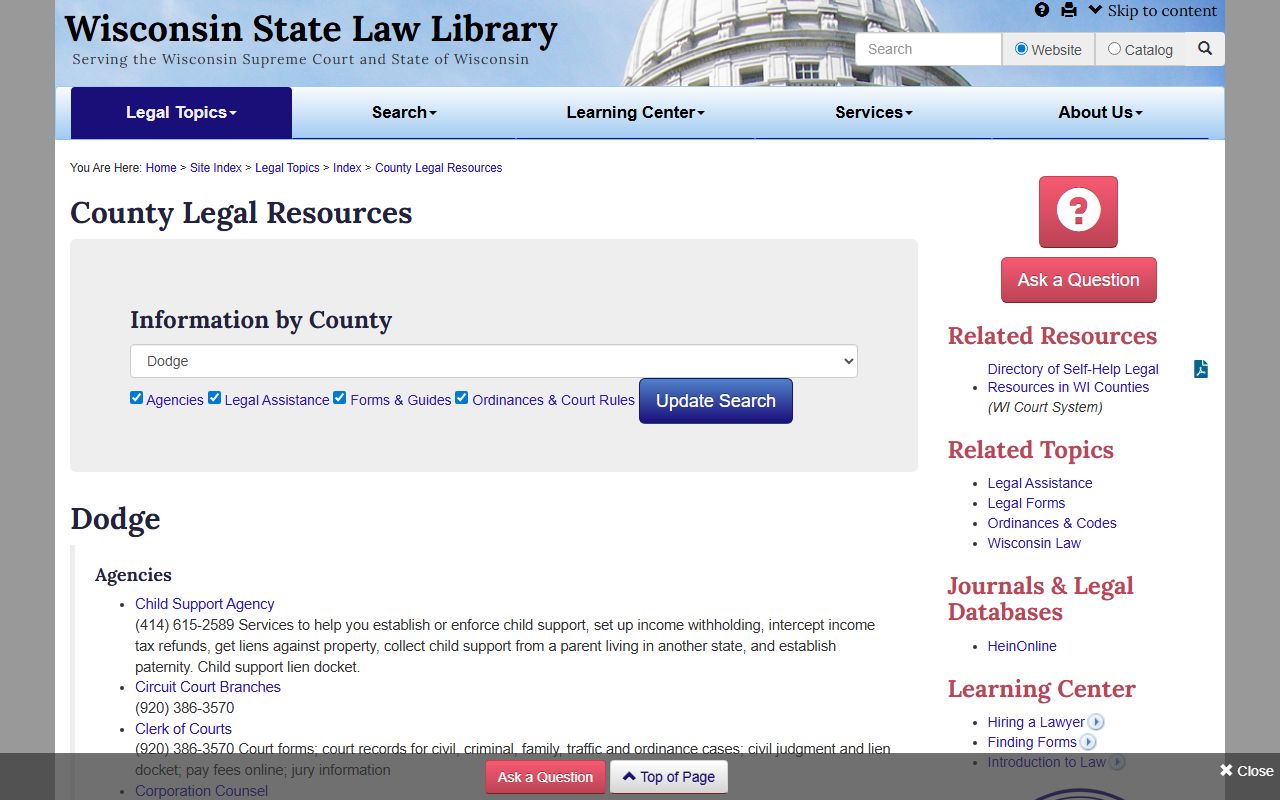
Use it when you want the official local map for the clerk, the family court commissioner, and the other county offices that touch a divorce case.
The county also gives the physical location for the court. The Justice Facility is at 210 West Center Street in Juneau, and the clerk office uses that same building for filing and record work. That is useful when you are planning a visit because a divorce file, a payment, and a question about a case can all start in the same place.
Note: In Dodge County, a court file, a divorce certificate, and a copy request each start in a different office, so the record type matters before you travel or mail anything.
How to Search Dodge County Divorce Records
WCCA is the fastest way to start a Dodge County Divorce Records search. The statewide portal lets you search public court records by party name, business name, case number, or other public case details. It can show docket history, case status, hearings, and other public entries. That makes it useful for a quick check before you call the clerk. If the file is public, WCCA usually gives you enough detail to know whether you are on the right track.
Wisconsin Circuit Court Access is the main search tool, but it is not the full file. The clerk office still controls the paper record. That is why the county FAQ and the state search tool work best together. One gives you the path. The other gives you the record.
Before you search, keep a few facts ready. They help you narrow the result set and avoid a long list of near matches.
- Full name of one spouse
- Approximate filing year
- Case number, if you have it
- County name and case type if you know them
The county FAQ is also useful here because it sets out the request method. If you need the actual court file, you can request it in person, by mail, or by fax. That is a better fit than trying to solve the search by phone. The office can then match the case name to the correct folder and tell you what to do next.
Dodge County Divorce Records Copies
Dodge County copy requests are straightforward. The county FAQ says copies cost $1.25 per page. For court documents, that is the main copy charge you should expect before you walk in. If you need the paper file and do not want to wait, the office can also guide you to the right request method. That is useful when a case has a lot of pages or when you only need one order or judgment page.
For divorce certificates, the county and state split the work. The Register of Deeds is the local office for vital records, and the state vital records office also issues divorce certificates. The state office keeps divorce records from October 1907 to the present and charges $20 for the first copy and $3 for each additional copy ordered at the same time. That difference matters. A court judgment and a certificate are not the same thing, and they do not come from the same desk.
The state vital records page at Wisconsin Vital Records explains the certificate side, while the state record page explains the difference between the Certificate of Divorce and the court decree. If you want to mail a request, the applications page gives the forms and instructions. That is the right route when you need a certificate from the state index instead of the county file.
For the legal side, Wis. Stat. 814.61 sets the base copy charge for family actions, and Wis. Stat. 69.20 and Wis. Stat. 69.21 explain certified vital records. That is the cleanest way to read the fee and eligibility rules without guessing.
Dodge County Divorce Records and Family Court
Dodge County family court work ties directly into the divorce record trail. The county law library page says the Clerk of Courts provides family court forms, and the family court commissioner is part of the local setup. That matters because a divorce case is not just a file. It also includes temporary orders, support issues, parenting plans, and service steps. If you are starting a case, you need the forms as much as you need the record search.
The county research lists forms and guides for pro se motions, contempt, enforcing placement orders, mediation, paternity interviews, and medical history questionnaires. That mix gives you a good start if the divorce includes children or post-decree work. The Wisconsin Court System divorce page also helps because it explains the basic flow in plain language and points you toward the right packet before you file.
Wisconsin Court System Divorce Help is the best statewide starting point for the process, and Circuit Court Forms gives you the actual forms. If you need to know whether you are working with a new filing or a post-judgment motion, those pages keep you on the right path.
- Pro se motions for family cases
- Contempt and enforcement forms
- Mediation and placement forms
- Paternity interview and medical history forms
Those forms are not advice. They are the paper trail the court needs to see. If you are not sure which packet fits, the county law library page and the court self-help page are better first reads than a random search result.
Dodge County Divorce Records Help
The Wisconsin State Law Library page for Dodge County is the best broad backup when you need local contacts and plain help text. It lists the Clerk of Courts, the Register of Deeds, the County Clerk, and the Child Support Agency, along with legal assistance groups. That is useful because divorce records often connect to support, custody, and old filing questions. Once you know which office owns the record, the rest is easier to manage.
Wisconsin public records law still matters here. Wis. Stat. 19.35 gives the public the right to inspect and copy records unless another rule limits access. Divorce files fit that rule, but sealed items, sensitive financial material, and some family-court records can still be restricted. That is normal. The public portal shows the open side. The clerk keeps the file.
If you are filing a new case, the statewide rules in Chapter 767 set the frame for residency, the no-fault standard, and the waiting period. That is why the record search and the filing process are tied together. A search helps you find the case. The statute tells you how the case moves. The clerk keeps the paper trail.
The county law library page is still the local summary to trust when you want a clean office list. It keeps the county work centered on the real offices in Juneau, not on a weak guide or a generic national site. That is the simplest way to keep the search local and accurate.
Tip: If you need the full decree, ask the clerk. If you need the certificate, ask the Register of Deeds or the state vital records office. If you only need the case status, start with WCCA.