
Search Iowa County Divorce Records
Iowa County Divorce Records are split between the courthouse file, the county vital records office, and the statewide case portal. That sounds like a lot, but the route gets simple once you know what you need. If you want the judgment, the Clerk of Circuit Court is the main stop. If you want a divorce certificate, the Register of Deeds can handle that request when the date fits the state system. If you only need a fast public check, WCCA is the clean first look. The key is to match the record type to the office before you spend time on the wrong desk.
Iowa County Overview
Iowa County Divorce Records Office
The Iowa County Clerk of Courts is the office that keeps the divorce case file. The State Law Library page says the clerk handles court forms, court records for civil, criminal, family, traffic and ordinance cases, the civil judgment and lien docket, online fee payment, and jury information. That makes the clerk the right office when you need the full divorce file, not just a case summary. The family court commissioner is also part of the local path, and that office helps people working through divorce, child support, mediation, paternity, and restraining order issues.
The county law library page at Iowa County Legal Resources is a strong local map because it puts the clerk, the family court commissioner, the register of deeds, and the register in probate in one place. That matters when a divorce record search grows into a family case question. One office may keep the file. Another may help with forms. A third may issue the certificate. Iowa County makes that split clear if you read the office list before you call.
This Iowa County Divorce Records image comes from the family court commissioner page at Iowa County Family Court Commissioner.
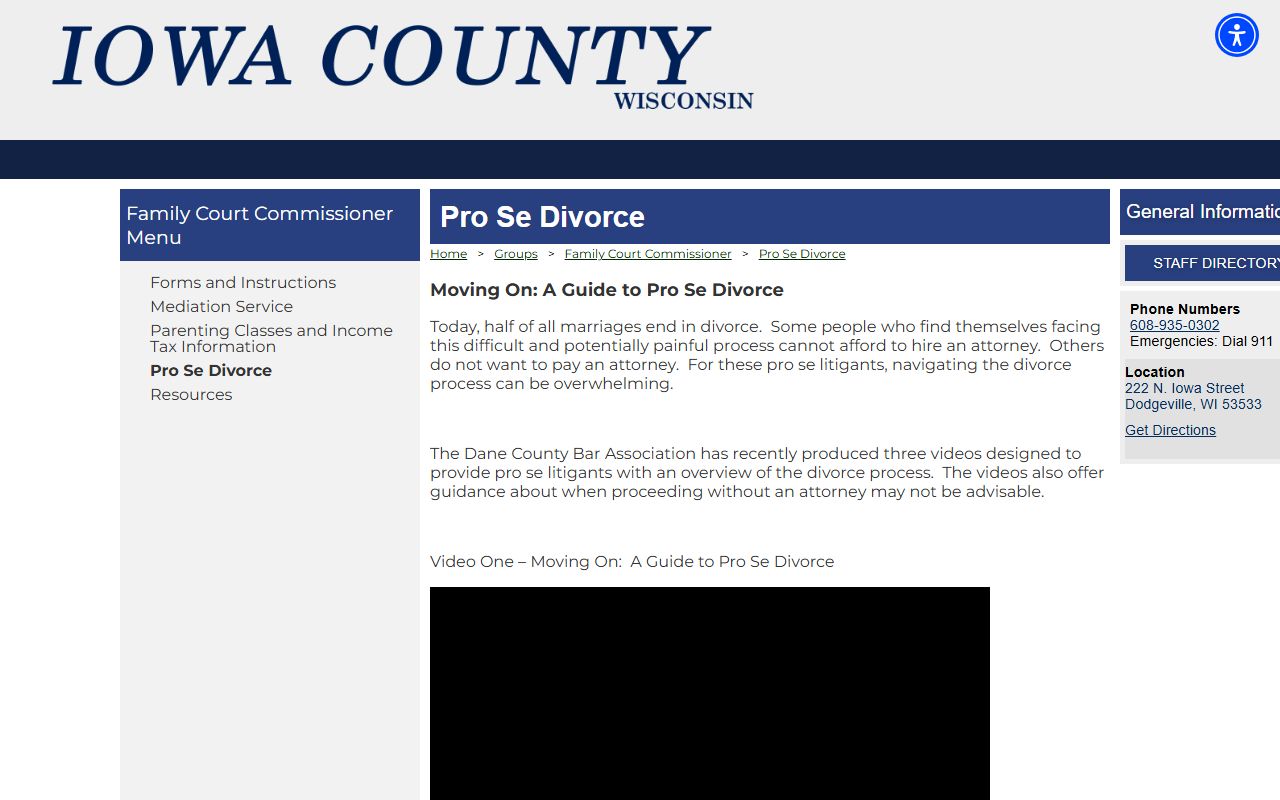
Use it when you need the local divorce guide, the paper forms path, or the office that helps pro se filers move a case forward.
The county pro se divorce page says paper forms for beginning a divorce may be available at the Clerk of Circuit Court office in the Iowa County Courthouse. That is useful if you are starting from scratch or trying to match a case number to the right packet. The page also says the clerk and family court staff can guide you to the forms that belong at the final hearing. That keeps the courthouse role focused on process and records, which is exactly where it belongs.
Note: In Iowa County, the clerk keeps the court file, the family court commissioner helps with divorce process steps, and the register of deeds handles the certificate side.
How to Search Iowa County Divorce Records
WCCA is the fastest public search tool for Iowa County Divorce Records. The statewide portal lets you search by party name, business name, or case number, and it gives you a public case summary with the docket history. It does not show the actual documents. It does not replace the clerk. It does help you confirm that the case exists before you ask the courthouse for copies. If you have a common surname, that first search can save a lot of time.
The public portal and the county forms pages work well together. The Iowa County official forms and applications page lists the Divorce or Separation Form and other court-related forms, while the state law library directory also points to general court forms for divorce, separation, and payment plan issues. If you are just starting, it is smart to check both before you file. That way you know whether you need a new case packet, a payment plan form, or a simple copy request.
Before you search, keep these details ready.
- Full name of one spouse
- Approximate filing year
- Case number, if you already have it
- County name if you want to narrow the search
The official portal is Wisconsin Circuit Court Access. The county and state pages also point to the broader court procedures directory at Wisconsin State Law Library Court Procedures by Topic. That page confirms that Iowa County provides general court forms for divorce, separation, and payment plan work, and it also notes a Request for Mediation form. Those details are useful when the search turns into an actual filing.
This Iowa County Divorce Records image comes from the county Register of Deeds page at Iowa County Register of Deeds.
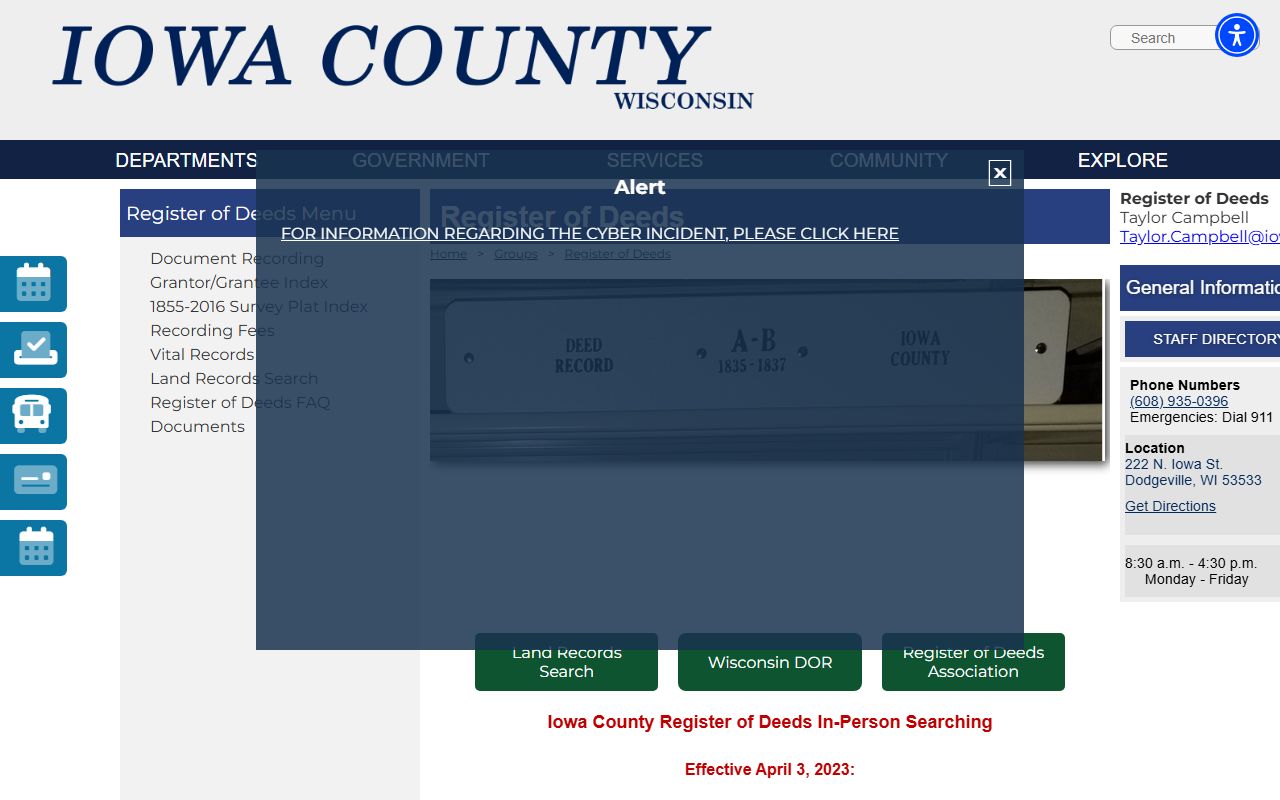
Use the register of deeds page when you need the certificate side of the search or the local office that handles vital records requests.
Iowa County Divorce Records Copies
The Iowa County Register of Deeds handles divorce certificate requests through the vital records process. The county says you can download a divorce application, complete all parts, and mail it with a self-addressed stamped envelope and the proper fee. The first copy costs $20, and each additional copy ordered at the same time costs $3. The county also says requesters must provide identification and show a direct and tangible interest to receive certified copies. If you are not a family member, a consent form can be used, but it must be notarized.
The county also adds practical rules that matter in person. There is zero tolerance for cell phones or other digital devices while searching, and only two people are allowed in the vault area at a time. Genealogy searches are open to the public at no charge, but copy fees still apply. Requests must be received by 4:00 p.m., and mail payments should be made by money order to the Register of Deeds. That is the kind of detail that keeps a request from stalling at the counter.
This Iowa County Divorce Records image comes from the county vital records page at Iowa County Vital Records.
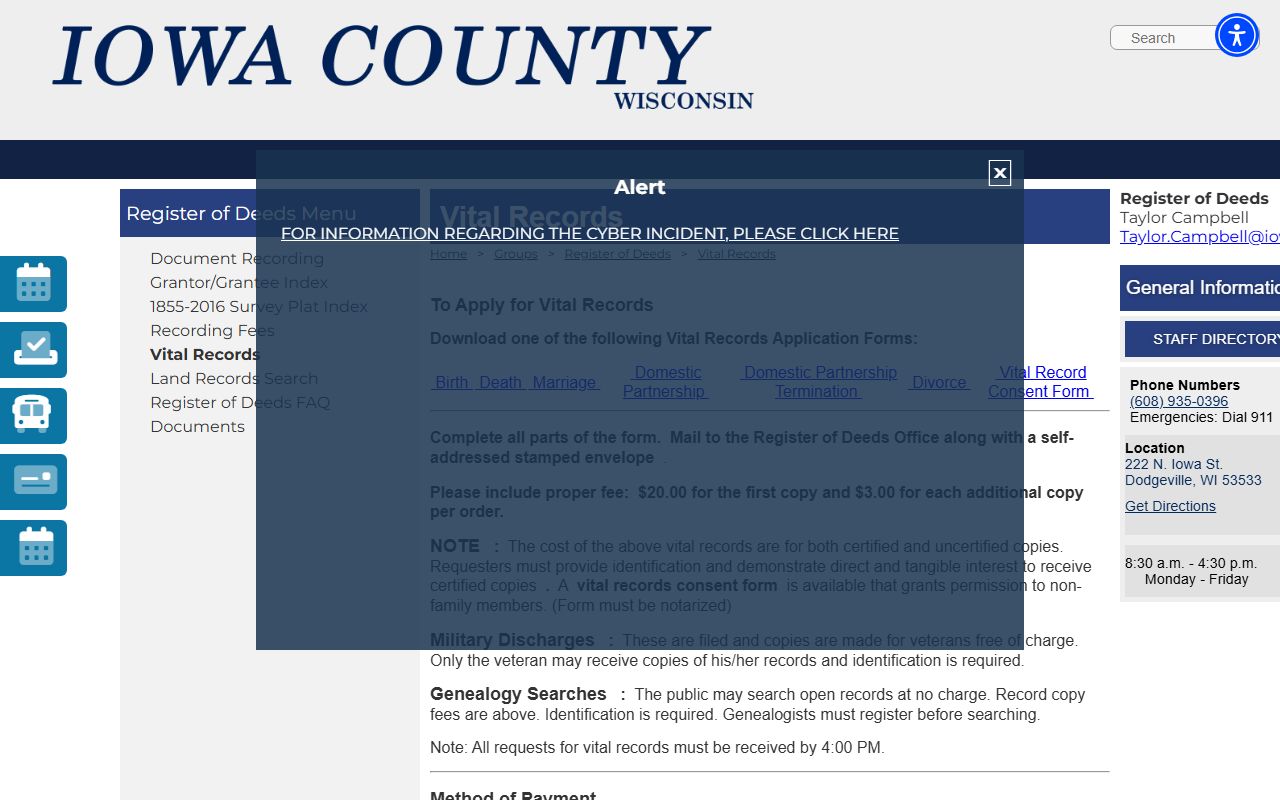
That page is the right stop when you need a divorce certificate or a copy of the county vital record.
The state office is still the backup route if you need a statewide certificate search or a verification. Wisconsin DHS Vital Records keeps divorce records from October 1907 to the present and explains the difference between the Certificate of Divorce and the court decree. The applications page explains the mail process, and VitalChek is the state's online and phone partner. The county and state systems overlap, but they do not issue the same paper.
For the legal frame, Wis. Stat. § 69.20 and Wis. Stat. § 69.21 explain who can receive certified copies and how registrars issue them. For court copy fees, Wis. Stat. § 814.61 sets the page charge and the related fee structure. That is why a certificate request and a court-file request are priced differently.
Note: A divorce certificate proves the event, but the court file still holds the judgment and the full case history.
Iowa County Divorce Records Forms
The Iowa County pro se divorce page is the best local starter when you need forms rather than a record copy. It says paper forms may be available at the Clerk of Circuit Court office in the courthouse, and it gives the sequence for the final hearing after the 120-day wait is over. The page also names the forms that pro se litigants need once the petition is filed. That is especially helpful when you are trying to finish the paperwork without a lawyer.
The county says you will need a Financial Disclosure Statement, a Marital Settlement Agreement, a Findings of Fact, Conclusions of Law and Judgment form, and a Vital Statistics form. Those documents are not optional decorations. They are the paper trail the judge needs to finish the case. The county forms and applications page also lists the Divorce or Separation Form and payment plan materials. That makes the official county site a good place to check before you drive to Dodgeville for paper copies.
Use Iowa County Pro Se Divorce and Iowa County Forms and Applications when you are building the packet. The county law library page and the state court self-help page are the best backup tools if you want a broader view of the family case flow. They show how the local forms fit into the statewide divorce process.
This Iowa County Divorce Records image comes from the county pro se divorce guide at Iowa County Family Court Commissioner.
Use it as the local guide for paper forms, hearing prep, and the final hearing checklist.
- Financial Disclosure Statement
- Marital Settlement Agreement
- Findings of Fact, Conclusions of Law and Judgment
- Vital Statistics form
Iowa County Divorce Records Access
Public access in Iowa County follows Wisconsin open records law, but the record type still controls the route. Wis. Stat. § 19.35 gives the public a right to inspect and copy records unless another law limits access. Wis. Stat. § 69.20 and Wis. Stat. § 69.21 control certified vital records. That means a court file, a divorce certificate, and a public docket entry are related, but they are not interchangeable.
The county law library page is the best broad local reference because it lists the clerk, the family court commissioner, the register of deeds, the register in probate, the child support agency, Family Advocates, Legal Action of Wisconsin, and LIFT Wisconsin. That is useful when the divorce record search turns into a live family-law problem. If you need only the record, the clerk or the register of deeds is the right place. If you need help understanding the form or the process, the law library and the state self-help pages are better.
The statewide self-help page at Wisconsin Court System Divorce Help is the best general backup. If you want the actual forms, the circuit court forms page at Circuit Court Forms keeps the packet organized. The public records and forms pages give you a clean path without sending you through a generic search site or a low-quality guide.
Use the county law library page at Iowa County Legal Resources when you need the office list again. It keeps the county contacts and the family support resources in one official place, which is exactly what makes a local divorce records search work.
Tip: The clerk keeps the court file, the register of deeds handles the certificate side, and WCCA is the public search tool that helps you find the right case first.